
Windows Thin Pc Iso
As the IT industry continues to be ever-changing, and server virtualization attains an even stronger foothold in your typical environment, desktop virtualization is not far behind. Once reserved for larger scaled environments, it’s now not uncommon to find a small business with only five users running a virtualized desktop environment. You can read and learn more about virtualization and.
This article discusses some basic configuration of the autounattend.xml answer file and necessary placement during the imaging process, allowing you to create the final image you desire using a manual deployment method. For an automated setup using Windows Deployment Services, please reference from my colleague,.
If you aren’t using them already, there are a number of tools you’ll need to familiarize yourself with. Visit for a pretty informative guide on those tools and their processes: For our purposes, we have configured the below settings. You will want to adjust accordingly to suit your needs. The below image is the Windows System Image Manager. You’ll do all of the configuration for your unattended files here.
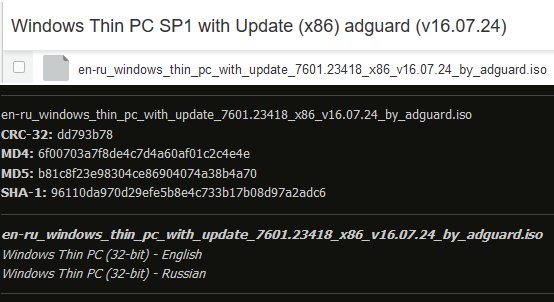
This Is The Official Windows Thin PC Download. It Supports All Software That Could Be Installed On Windows 7. Named 'en_windows_thin_pc_x86_697681.iso'.
From the Top, Down Win PE - Microsoft Windows International Core and Its Sub-Setting, Setup UILanguage This will bypass the following language settings prompt. Microsoft Windows Setup Neutral, Disk Configuration, Create Partition and Modify Partition These values will reference a physical hard disk, create the necessary system partition, size it and extend the remaining partition for Windows. You will be bypassing the following disk creation prompt. OS Image and Install To These will simply decide which partition, specified above, will have Windows installed. User Data This will enable you to accept Microsoft’s End User License Agreement and bypass the following.
Specialize – Microsoft Windows International Core This is the same as above, but placed in a different location to ensure functionality. Select en-US for United States. Specialize - Microsoft Windows Shell Setup Neutral Here, we will specify the Time Zone for the machine and the copy profile from administrator function, which ensures all audit mode settings are retained from the profile.
We’ll also enter the Product Key for activation. OOBE System – Reseal This option is for after the sysprep is run. This should put you into OOBE but not force the shutdown of the machine. Microsoft Windows International Core Neutral This, again, is to bypass the same screen as above, only after the installation portion is completed and the system deployed. Microsoft Windows Shell Setup Neutral This is for the Time Zone as above. Like before, this is now after the system has been deployed.
Auto Logon and its sub-field, Password: This actually serves two functions. It allows the administrator account to log on a certain number of times and automatically without user interaction to run necessary scripts or anything else. However, if Auto Logon is not enabled, you will run into issues enabling the local administrator account. I found it best in my tests to configure this way.
First Logon Commands These are commands that will run when the account is logged on. Synchronous Commands will run one after the other. Notice below that we have a script described as a domain joining script. NOTE: Choosing an unattended domain join is successful. However, in our case, we ran into issues with Active Directory. Since WDS is not in use, you’ll have to manually name the machine.
On Windows 7 Thin, the domain joining process occurs early on in the setup stage. Joining the domain that way while attempting to rename the machine later will cause issues not referencing AD. This will ultimately cause logon errors. To avoid this issue, we created the following VBS script that will join the proper domain and organizational unit.
This script is referenced in the batch file you see above. OOBE This is the same as above. However, like before, it’s after the image is deployed and ready to go. It shows specifications for hiding the Eula, selecting the network location and taking the user out of the mix.
User Accounts, Administrator Password, Local Accounts, Local Account and Password This is pretty straight forward here. You’ll fill in a local admin password. In our case, we ran into issues if we just left the local account field blank. We created a local account called Admin, added a description and placed it in the local administrators group on the machine. That concludes the configuration portion of the unattend.xml file in our case. There are a few more steps you must go through to get this all working properly. To start the imaging process, you will boot to disc or USB device with a Thin OS image on it.
Windows Thin Pc Software
You must, however, have the autounattend file available in the root directory of whatever media you are using. So, if you are using a USB drive, place the file on the root with the rest of the files. If you are using a disc, you’ll have to extract the contents and recreate the ISO with the file and all other contents on the root. After the initial installation, you will be stopped at the computer name screen. Do not proceed. From here, you will press Ctrl+Shift+F3. This will restart and take you into audit mode.

Log in with the local administrator account to install programs, run updates and make any setting changes you see fit. Please note that a major fix involving activating Windows with a MAK key has been addressed with Microsoft’s KB2691967 available. Please download and install to make sure your image is as up-to-date as possible. After you complete this step, you will want to run a sysprep to prepare the image to be copied.
Use the following command. Take note that the location you specify must be where you place the autounattend file.
Command: Sysprep /generalize /oobe /shutdown /unattend:c: chosen location autounattend.xml For disc creation:. Follow the guide you downloaded earlier, boot to the Win PE media and extract the image. Extract the.wim file and place it on a USB drive instead of a network share. Go back and extract the contents of the original Windows 7 Thin disc.
Copy the contents of the disc to a separate folder. Navigate to the sources folder and delete the factory install.wim file. Paste the new install.wim file you extracted into this location. You will notice that this file is bigger than the original.
That is because it contains all of the changes you have made installing updates and such. Repackage the contents into an ISO, make sure it is bootable and remember to place the autounattend file on the root of the image too. For USB drive creation, follow the same steps as above and add the following:.
Go to and download the tool. Install and follow the prompts. Run the program. You will be asked which ISO and USB drive you want to use. You should now have an almost-fully-automated installation, aside from the machine name.
This thread has missing the point at some point in the comments, this is for slimming down your 7 Starter, Home Basic-Premium, Pro, Ultimate as much as a ThinPC edition, only make sure to check compatibility for office and all what you would like to keep and if there is telemetry/Consumer experience index, uncheck them, to be safe. If you want to have a Thin PC OS like in your local language, it would be possible by doing the following: Download the 'Windows 7 Thin PC' evaluation ISO and extract to a folder from the official link: 1.- Open NTLite 2.- Add the source dir 3.- Load the image 4.- Go to Components tab 5.- Click on Compatibility toolbar icon 6.- Uncheck all and click on Ok 7.- Now go to Source tab 8.- In the Presets' toolbar (if not enabled, click on Presets' tab on top of the toolbar or on the presets panel side to enable the presets toolbar) 9.- Click on Save as. Icon and name it as ThinPC or type your prefered name Repeat the steps for a full Windows 7 edition (Home Basic - Ultimate) but a step 9 use the OS name edition instead of ThinPC 10.- Make a backup of the preset files (recommended to copy to another folder). 11.- Compare ThinPC and Windows 7 edition (Home Basic - Ultimate) preset files 12.- Remove from Windows 7 edition (Home Basic - Ultimate) preset file the lines found between and in the Thin PC preset file. 13.- Click on New session in the Presets toolbar 14.- double click on the Windows 7 edition (Home Basic - Ultimate) 15.- Click on Apply tab 16.- Check Create ISO and enter the file and label names 17.- Click on Start in the toolbar icon. Recommendations: After loading the finished Windows 7 edition (Home Basic - Ultimate) preset file, you can load it in a Windows 7 session but make sure to check in components the basic that you would need, like.NET Framework 3.5.
If you don't have an utility to compare text files, you can use from Scooter Software, free trial version works ok (at least v3), after 30 days you can still use it, i don't really know it's limitations (other than popups on start), as i use it only the very basic for comparison. Note: Read the 'Release Notes.htm' file for missing features in ThinPC. Pmikep, Windows 7(Ultimate and Pro) bareboned can run video editing and production software(Sony Vegas and Soundforge), makes an excellent DAW(REAPER, Audacity, Wavosaur). You will need to check for.Net and other dependances and whether your chosen software can be activated offline because i removed nealy all networking, If i am correct ThinPC could only run 4 applications at a time. Besides, if you build a thinpc from scratch then you need to know which packages you need to build the bloody thing. I recall reading limitations on the apps that ThinPC could run too - and IIRC, they were even more Draconian.
Like, you couldn't run true apps. (Office was given as an example.) As it's name suggests, it was meant to be just enough of an OS that you could hook up to the cloud and do your work remotely. Even if it could run major apps, the thought of an OS that was designed to hook up to the cloud and run (and be run) is just the opposite of what I'm trying to achieve with my NTLite'd version of Win7, where I have removed all the Remote stuff. Pmikep, Thin PC weighs in at a svelte 2.8 GB, 32 or 64bit because my 2.9gb is for Ultimate 64bit updated, not a like for like comparison if Thin is 32bit.
Registration Agreement
If my preset is used on Ultimate 32bit then i estimate it would be 500mb to 1gb smaller than 64bit, a fair bit smaller than thin 32bit. 64bit Thin would be 500mb to 1gb larger so my preset compares favourably then. I am still bruised over trying to get drivers and installers to run when 'this does not support X os' etc. Then there is the licensing and activation issue.
Windows 7 Thin Pc Iso
Many also have legit licenses/activation for the mainstream editions and prefer toremain legit. I prefer to use the Blydenstein method.